Fart Together speedrun: 2P Practice and Timing
Build a Fart Together speedrun practice plan with 2P coordination tips, timing checks, and context for a video labeled as a 12:21 world record.
Turn Co-op Chaos Into a Repeatable Run
A Fart Together speedrun turns a ridiculous premise into a serious coordination test: two players need one shared plan. That matters because an input that feels helpful individually can send the whole team off course. This Fart Together speedrun guide explains how to approach two-player practice, evaluate a video labeled as a 12:21 world record, and measure improvement without confusing an upload title with a verified leaderboard result.
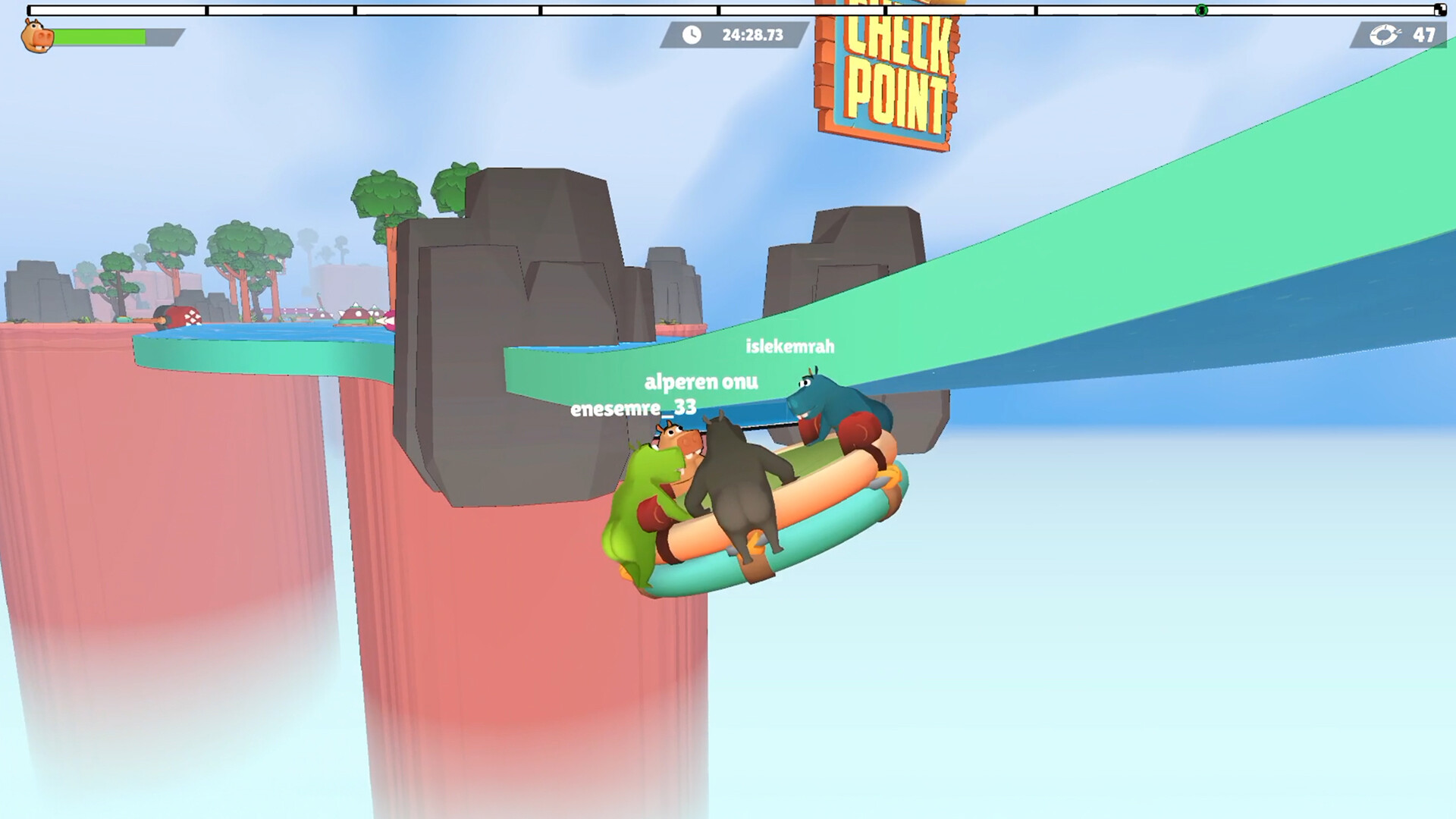
Official screenshot · Source: Steam store
The available references offer a useful starting point, but not a complete competitive rulebook. One YouTube upload advertises a two-player completion time, while a Google Play listing describes physics-based boat movement and cooperative obstacle courses. Neither establishes official timing rules or confirms that both references show the same release.
The practical approach is to separate documented information from practice recommendations, then build a route your team can reproduce.
What the 12:21 Video Actually Establishes
The referenced upload, titled “[WR] Fart Together 2P - 12min21sec,” presents itself as a two-player world-record run. Its advertised time converts to 741 seconds.
That is a useful number for identifying and studying the upload—not proof that it remains the fastest accepted run as of October 23, 2026. The supplied material does not include a leaderboard, verification decision, submission date, platform, or timing definition.
You can use the two-player Fart Together video labeled as a 12:21 world record as a viewing reference. Its supplied transcript consists mostly of brief reactions and sound effects, so it does not support a detailed route breakdown.
| Reference detail | What it supports | What it does not establish |
|---|---|---|
| “2P” in the video title | The uploader labels the run as two-player | Official category requirements |
| “12min21sec” in the title | An advertised completion time of 12:21 | Exact timer start and finish events |
| “[WR]” in the title | A world-record claim by the uploader | Independent verification or current standing |
| Supplied transcript | Reactions and audio fragments | Specific shortcuts, inputs, or obstacle strategies |
| Google Play description | Advertised boat movement and co-op features | A confirmed match to the video’s version |
Check the version before comparing times
The Fart Together Google Play listing describes solo play, co-op for up to four players, and a shared boat propelled through physics-based challenges. It also describes narrow passages, moving obstacles, and the consequences of poorly timed inputs.
Those details support general advice about coordination. They do not justify assuming that a mobile attempt and the referenced video use identical courses, controls, or physics.
Before chasing a Fart Together speedrun benchmark, confirm:
- Game identity: Are you playing the same release shown in the reference?
- Platform and version: Could an update or port affect movement?
- Player count: Does your comparison use the same team size?
- Course and completion goal: Are both runs finishing the same content?
- Timing method: Are you measuring the same start and finish events?
Until those match, treat 12:21 as an advertised reference time rather than a fair personal target.
Build a Two-Player Movement Plan
For the boat-based gameplay described in the listing, the central challenge is shared control. Every player can affect the team, so improvement starts with agreement—not simply faster reactions.
A useful Fart Together speedrun practice session should answer three questions: who calls the next action, what cue triggers it, and what happens if the approach goes wrong?
Assign communication roles
As a practice experiment, designate one player as the caller for a difficult section. The other player follows the agreed cue instead of adding an unplanned correction. You can switch callers between sections if one person reads a particular obstacle more reliably.
This is a communication strategy, not a claim that the game assigns different mechanical roles.
| Situation | Suggested team agreement | What to watch during review |
|---|---|---|
| Open approach | Agree on direction before committing | Corrections caused by conflicting intentions |
| Narrow passage | Choose one caller for the entry | Extra inputs after the line is established |
| Moving obstacle | Name a visible cue for the attempt | Whether both players respond to the same event |
| Unstable approach | Use one short recovery command | Whether players attempt competing recoveries |
| Repeatable section | Keep the same call sequence | Whether consistent calls produce consistent results |
Short commands are easier to use under pressure. Try “ready,” “go,” “hold,” and “recover,” but define them first. “Hold” should not mean “stop pressing” to one player and “maintain the current action” to the other.
Practice the approach, not just the obstacle
A successful crossing is difficult to repeat if every attempt begins from a different position or direction. When reviewing footage, look backward from the mistake.
Ask whether the problem began before the obstacle:
- Was the boat already misaligned?
- Did the team make a late correction?
- Did one player act before the agreed cue?
- Was the entry different from the previous successful attempt?
For your Fart Together speedrun route, write down recognizable entry conditions. A note such as “approach facing the opening, then use the agreed cue” is more useful than “do the hard part correctly.”
Avoid prescribing exact burst lengths or button sequences until you have tested them in your version.
Practice for Consistency Before Chasing Pace
Full runs measure progress, but focused repetitions help explain it. If one section repeatedly causes trouble, spending an entire session reaching it may produce very little useful practice.
Use the closest repeatable setup available in your version. If there is no convenient restart or checkpoint, make each full-run attempt answer one specific question.
Use a small, measurable practice block
The following is a suggested training format, not a game rule or established community standard.
| Practice block | Suggested repetitions | Main goal | Record this |
|---|---|---|---|
| Establish a baseline | 3 complete attempts | Find recurring problems | Total time and major mistakes |
| Repeat a difficult approach | 10 attempts | Stabilize entry conditions | Clean completions out of 10 |
| Test communication | 10 attempts | Remove conflicting calls | Missed or misunderstood cues |
| Try a faster variation | 10 attempts | Compare risk against savings | Completion rate and section time |
| Return to full runs | 3 complete attempts | Check whether practice transfers | Total time and remaining trouble spots |
Ten attempts will not establish a precise long-term success rate. They are simply a manageable first sample that can reveal an obviously unreliable idea.
For example, if a route works only three times in ten trials, its fastest result may not be the best choice for your next completion attempt. Keep testing, or use a safer approach while improving the risky one separately.
Judge shortcuts by their failure cost
A fast route is only useful if its time savings justify its risk.
Consider a hypothetical shortcut that saves two seconds when successful but adds eight seconds when it fails. At an 80% success rate, the average saving is zero: eight successes save 16 seconds, while two failures lose 16 seconds.
That example is not a measured Fart Together result. It illustrates why a Fart Together speedrun strategy should account for recovery time rather than celebrate only its best attempt.
Use a simple practice log:
- Successful section time
- Number of clean completions
- Typical failure penalty
- Whether a failure ends the attempt
- Conditions that seem to affect consistency
For a first clean finish, reliability may matter most. For a later personal-best attempt, accepting more risk can be reasonable.
Time, Review, and Document Your Attempts
An accurate Fart Together speedrun comparison needs more than a stopwatch screenshot. It needs a clear explanation of what was timed.
If you find an established leaderboard, follow its published rules. If you have not found one, label your results as personal practice times and keep your measurement method consistent.
| Item to document | Why it matters | Practical approach |
|---|---|---|
| Platform and game version | Builds may behave differently | Record the platform and visible version information |
| Player count | Team sizes may not be comparable | Label two-player attempts clearly |
| Start event | Different starts change the result | Write down the exact event you use |
| Finish event | Ambiguous endings create inconsistent times | Choose a clearly identifiable completion event |
| Pauses and interruptions | They can distort comparisons | Note them rather than silently removing them |
| Recording continuity | Missing footage limits review | Preserve the complete attempt when possible |
Use splits to locate losses
Divide your route into a few recognizable sections and record the elapsed time at each boundary. You do not need sophisticated tools to begin; a spreadsheet and a recording can be enough.
Compare section times against your own baseline before comparing against someone else’s run. This helps distinguish a faster overall attempt from one that merely had an unusually strong opening.
| Review finding | Likely practice priority |
|---|---|
| Similar losses at the same obstacle | Rework the approach or cue |
| Large variation across many sections | Simplify communication and stabilize movement |
| Fast sections followed by costly failures | Reassess route risk |
| Consistent completion with small delays | Test one optimization at a time |
| Unexplained timing differences | Recheck timing boundaries and interruptions |
Separate gameplay problems from app interruptions
Player experience: Reviews included with the Google Play reference report frequent ads, and one reviewer also reports crashes. These are individual accounts, not verified conditions for every installation or evidence about the version shown in the speedrun video.
If your installation has similar interruptions, test it before a serious recording session. Note whether interruptions occur before gameplay, during play, or around menus.
Do not assume you can remove interrupted time from a competitive submission. Any accepted treatment would depend on the relevant rules.
For each recorded attempt, finish with a short review: one thing that worked, one recurring mistake, and one change to test next. That keeps practice focused without turning every run into a complete route redesign.
FAQ: Fart Together Speedrun Basics
What is the Fart Together speedrun world record?
The supplied reference includes a video labeled “[WR] Fart Together 2P - 12min21sec.” It advertises a two-player time of 12 minutes, 21 seconds, but the available material does not verify its current world-record status. Check an active leaderboard and its verification rules before presenting it as the standing record.
Does the 12:21 video show the same game as the Google Play listing?
The supplied references do not establish that connection. They share the Fart Together name, but the provided video transcript does not identify its platform, build, or course. Confirm those details before applying the listing’s mechanics to a specific run or comparing completion times.
What should beginners practice first?
Start with clear communication and repeatable approaches. Agree on short calls, identify a recognizable entry condition for a difficult section, and record how often you complete it cleanly. Once the team can reproduce that section reliably, test faster variations one at a time.
Should I copy a fast run’s route immediately?
Use it as a source of ideas, not an automatic prescription. First confirm that the version and category match, then test individual sections. A route that produces a faster best case may still cost you time through failures. Build a dependable completion route first, then add risk where your practice results justify it.
Related Guides
Fart Together 2P speedrun: 12:21 Run and Practice Guide
Explore the 12:21 Fart Together 2P speedrun claim, learn what the sources confirm, and build a practical two-player training plan.
Fart Together world record: How to Verify a Run
Looking for the Fart Together world record? Learn what the available sources confirm, how to verify a run, and which timing details matter.
Fart Together steering guide: Turns, Timing, and Gas
Improve raft steering with practical tips for gas bursts, sharp turns, moving hazards, and co-op timing, plus clear PC and mobile distinctions.
Fart Together 2P: Two-Player Co-op Guide and Tips
Explore Fart Together 2P, including two-player support, online co-op details, teamwork tips, PC requirements, and the planned Early Access release.
Fart Together demo gameplay: Co-op Tips and Guide
Explore Fart Together demo gameplay, 2–4-player raft controls, teamwork tips, PC requirements, and how to download the free Steam demo.