Fart Together steering guide: Turns, Timing, and Gas
Improve raft steering with practical tips for gas bursts, sharp turns, moving hazards, and co-op timing, plus clear PC and mobile distinctions.
Start Here: Steering Is About More Than Direction
One badly timed burst can turn a clean approach into a collision. This Fart Together steering guide helps you separate direction, power, and timing so you can understand why the raft misses its line. Use this Fart Together steering guide to build controlled movement first, then tackle tighter turns and coordinated maneuvers.
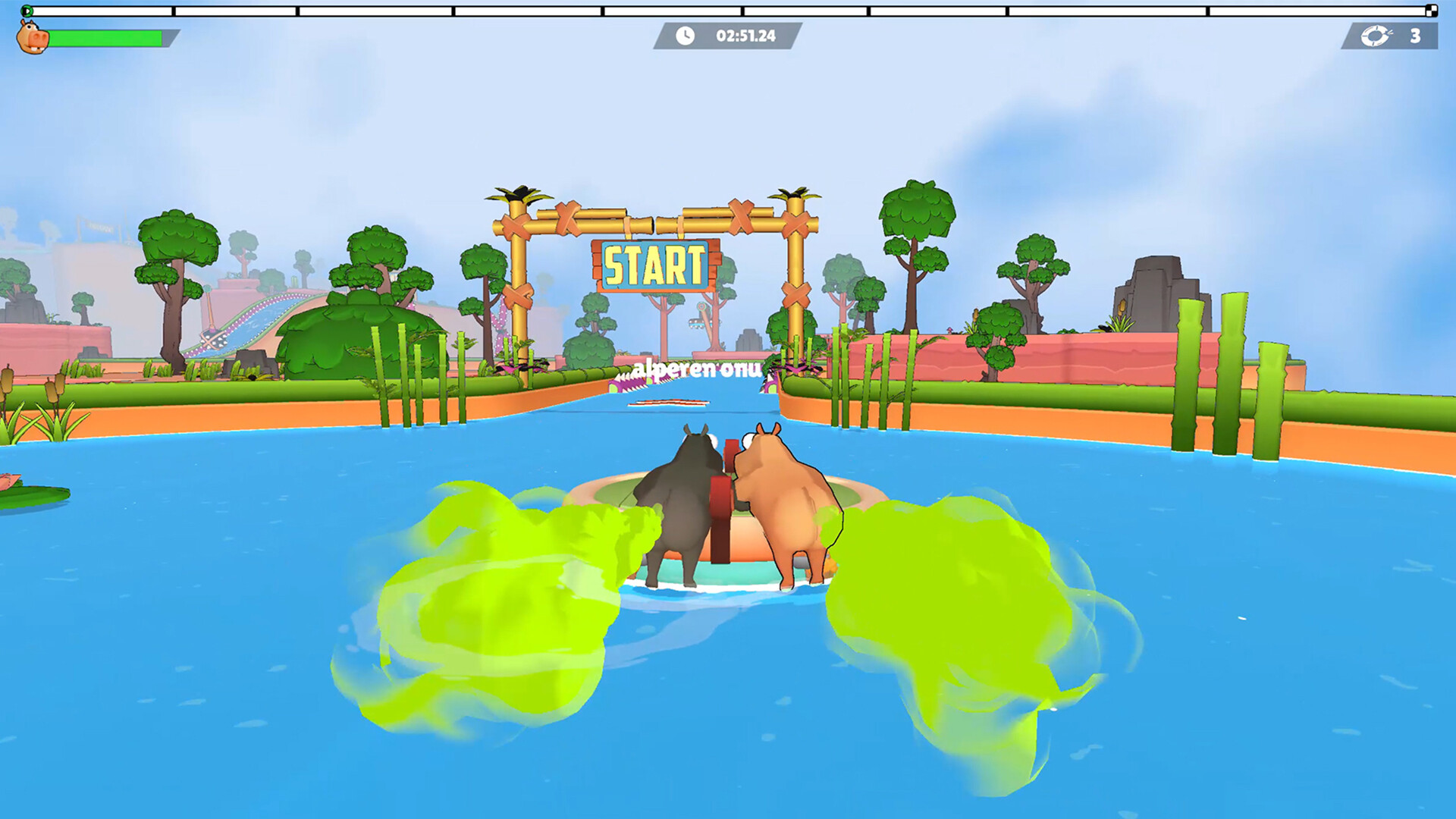
Official screenshot · Source: Steam store
Before practicing, check which game listing you are using. The supplied sources describe different experiences under the same name: a community guide discusses a Windows co-op demo, while the official Google Play listing describes a single-player mobile game. Their controls and features should not be treated as interchangeable.
| Detail | Windows co-op demo: community reports | Mobile: official Google Play listing |
|---|---|---|
| Player setup | 2–4 players influencing one raft | Single-player raft racing |
| Steering challenge | Coordinating teammates’ direction, force, and timing | Managing boost angle, strength, and momentum |
| Input information | A keyboard-only option is reported | Touch controls are advertised |
| Resource considerations | Stamina management is reported | Chargeable fart boosts are advertised |
| Availability information | Community material discusses a demo | The supplied listing invites preregistration |
The official Fart Together Google Play listing supports the mobile details above. For PC-specific claims, the available reference is the community guide to Fart Together controls and co-op play, not official control documentation.
Neither supplied source establishes exact keyboard bindings, touch gestures, turning rates, or a universal best boost duration. Check your version’s instructions rather than relying on an invented button combination.
The central lesson of this Fart Together steering guide is simple: identify what your input changes before adding more of it. A stronger push is not automatically a better correction.
Learn Direction, Power, and Timing Separately
A useful practice session answers three questions: Where does this input send the raft? How much does it change movement? When does that change become useful?
On mobile, the official description explicitly connects boosts with speed, angle, direction, and momentum. For the PC demo, community reports say each teammate’s direction, force, and timing influence the shared raft. Those descriptions support practicing the variables separately, even though they do not establish identical physics.
Run a Low-Risk Steering Test
Choose the clearest stretch available and aim toward an easy-to-recognize landmark. Avoid testing several unfamiliar inputs at once.
| Practice step | What to do | What to observe |
|---|---|---|
| Establish a direction | Choose a visible destination and make one deliberate input | Whether the raft travels toward the intended space |
| Compare power | Try a restrained input, then a stronger one where supported | How much the raft’s movement changes |
| Observe afterward | Leave a brief gap before another correction when safe | Whether existing movement still carries you away from the target |
| Test timing | Repeat a similar approach with an earlier input | Whether preparing sooner improves the line |
| Repeat deliberately | Keep the destination consistent | Whether the result becomes more predictable |
These are suggested exercises, not hidden game mechanics. Their purpose is to make cause and effect easier to recognize.
Separate Where You Face From Where You Travel
For the mobile game’s advertised momentum-based movement, pointing toward an opening does not necessarily mean your current path will carry you through it. Watch the raft’s actual travel, not just its orientation.
A practical check is to ask: “If I add nothing right now, where am I headed?” That question helps distinguish a direction problem from an unnecessary acceleration.
On mobile, compare charge strengths in a safe area. Stronger boosts are advertised as useful for difficult sections, while careful bursts are described as helpful around tight bends. Do not assume a full charge is the default answer.
This part of the Fart Together steering guide is about learning a repeatable response—not finding one power setting that works everywhere.
Coordinate Co-Op Steering Without Competing Corrections
According to community reports, the Windows demo places 2–4 players on a shared raft. That makes communication part of steering: a teammate can understand the destination but still act at the wrong moment.
The most useful co-op habit is to agree on one maneuver at a time. Avoid asking the crew to interpret a destination, a speed change, and several shouted corrections simultaneously.
Give Each Call a Clear Job
Try this suggested communication format:
- Target: Identify the opening, bend, or other visible destination.
- Action: State the intended maneuver.
- Cue: Use one agreed word to begin.
- Status: Speak up immediately if you cannot perform the action.
For example: “Through the gap ahead. Small correction on ‘go.’ Ready—go.”
“Small correction” is a team instruction, not a named in-game command. Your group must first establish what that means with its available controls.
| Communication problem | Why it disrupts steering | Better team habit |
|---|---|---|
| Several players give directions | Teammates may follow different plans | Choose one caller for the maneuver |
| “Left” means different things | Players may use different reference points | Name a visible opening or landmark |
| Someone acts after everyone else | The late input changes an already-started maneuver | Use one consistent action word |
| A player cannot contribute | The crew expects an input that never arrives | Announce availability before the cue |
| Corrections overlap | Nobody can identify which action helped | Give each correction time to produce a visible result when safe |
Include Stamina in the Plan
The community guide reports stamina management in the demo. If that applies to your build, tell teammates when you cannot join the planned action. A short warning is more useful than silently missing the cue.
Likewise, avoid treating the caller role as permanent authority. Rotate it when another player can better explain the next obstacle. The goal is a shared plan, not constant commentary.
For co-op players, the most important takeaway from this Fart Together steering guide is that coordinated, understandable inputs are easier to improve than four independent rescue attempts.
Approach Narrow Gaps, Sharp Turns, and Moving Hazards
Different obstacles expose different steering mistakes. A narrow opening tests your approach line; a sharp bend tests preparation; a moving hazard tests your choice of entry time.
The mobile listing advertises obstacles including spinning hazards, floating bumpers, rocky barriers, and narrow passages. Community reports also describe tight passages, sharp turns, and moving obstacles in the co-op experience. Do not assume both versions contain the same layouts or hazard behavior.
| Challenge | Prepare before entering | During the maneuver | Review after a miss |
|---|---|---|---|
| Narrow passage | Choose the intended path through it | Avoid unnecessary competing corrections | Was the approach already off-line? |
| Sharp turn | Identify the exit and begin planning early | Match power to the available space | Did the correction begin too late? |
| Moving hazard | Watch how the opening changes | Commit to the selected opportunity | Did you choose a poor moment or execute poorly? |
| Collision recovery | Identify the new direction of travel | Reassess before adding more force | Did recovery inputs worsen the original mistake? |
Narrow Passages: Solve the Approach First
Aim for a path through the opening, not merely toward its nearest edge. Entering at an awkward angle can leave you needing a correction where there is little room to make one.
In co-op, confirm that everyone means the same opening. On mobile, watch whether the raft’s travel matches the intended route before adding another boost.
Sharp Turns: Plan Around the Exit
Look beyond the bend when the view allows it. Knowing where you want to finish makes the initial steering decision more useful.
If you repeatedly overshoot, try changing one variable on the next comparable attempt: prepare earlier or use less power where your controls allow. Changing both together makes it harder to learn which adjustment helped.
Moving Hazards: Observe Before Committing
Watch enough movement to identify a promising opening when the approach gives you time. Avoid assuming a precise repeating cycle unless you have actually observed one.
In co-op, agree on the action cue before reaching the danger zone. On mobile, consider whether your chosen boost will carry you farther than the currently open space permits.
Apply this Fart Together steering guide as an observation routine: read the obstacle, choose a route, act, and compare the result with your intention.
Troubleshoot Mistakes With a Short Practice Routine
A collision tells you where the attempt ended, but not necessarily where it went wrong. The decisive mistake may have happened earlier: an unclear destination, excess power, or a late correction.
After a failed attempt, describe the sequence before assigning a fix. “We entered diagonally, then added power” provides more useful information than “the steering felt bad.”
| Symptom | Possible explanation to test | Next experiment |
|---|---|---|
| Repeated overshooting | Too much power or late preparation | Change only power or timing |
| Raft heads toward the wrong space | Destination or directional input was misunderstood | Use a clearer visual target |
| Approach works until the last moment | A late correction may be unnecessary | Observe the existing path before acting |
| Co-op turn suddenly becomes chaotic | Inputs or instructions may overlap | Use one caller and one cue |
| Same obstacle produces inconsistent results | Several variables may be changing together | Repeat a similar approach with one adjustment |
A focused practice loop can be short:
- Choose one skill. Work on approaching a gap, not completing the whole course quickly.
- Predict the result. State where you expect the raft to travel.
- Make the attempt. Keep the plan simple.
- Name the first visible mistake. Separate that from later panic corrections.
- Change one thing. Repeat while the previous attempt is still easy to remember.
For mobile players, the listing advertises quick retries and checkpoints where available. Use those opportunities to practice a troublesome section rather than chasing a personal best immediately.
This Fart Together steering guide recommends consistency before speed. Once you can explain why an approach works, you have a better foundation for attempting it faster.
FAQ
What is the most important tip in this Fart Together steering guide?
Separate direction, power, and timing. Determine which one caused the missed approach, then change that variable first. In co-op, also confirm that teammates understood the same destination and action cue.
What buttons do you use to steer in Fart Together?
The supplied references do not establish exact bindings. Community reports mention a keyboard-only option for the PC demo, while the official mobile listing advertises touch controls. Check the instructions in your installed version for specific inputs.
Is Fart Together single-player or multiplayer?
The sources describe different experiences. The community PC guide discusses a 2–4-player co-op demo, while the official Google Play listing describes a single-player mobile game. Verify the platform and listing before expecting multiplayer.
Should you always use the strongest boost?
No. The mobile listing describes stronger boosts as useful for demanding sections and careful bursts as useful around tight bends. Choose power based on the space ahead. For co-op, community reports emphasize coordinating force, direction, and timing rather than simply adding more gas.
Related Guides
Fart Together first time: A Couple's Comfort Guide
Nervous about farting in front of your partner? Learn how to handle the first time, talk about boundaries, and keep an awkward moment comfortable.
Fart Together how to play: Co-op Beginner's Guide
Learn how to play Fart Together with friends, coordinate raft movement, tackle obstacles, and prepare your PC for the free Steam demo.
Fart Together raft Guide: Steering and Co-op Tips
Master the Fart Together raft with practical steering, timing, obstacle, and co-op tips. Learn what differs between the Steam and mobile listings.
Fart Together 2P: Two-Player Co-op Guide and Tips
Explore Fart Together 2P, including two-player support, online co-op details, teamwork tips, PC requirements, and the planned Early Access release.
Fart Together demo gameplay: Co-op Tips and Guide
Explore Fart Together demo gameplay, 2–4-player raft controls, teamwork tips, PC requirements, and how to download the free Steam demo.