Fart Together tutorial: A Beginner’s Co-op Guide
This Fart Together tutorial explains raft teamwork, beginner practice drills, obstacle strategies, and what to know before Early Access.
Start Here: How Fart Together Works
One mistimed blast can turn your entire crew’s perfect approach into a raft-shaped disaster. This Fart Together tutorial focuses on the coordination that matters: understanding your inputs, agreeing on directions, and making corrections without fighting your teammates. Use this Fart Together tutorial to plan your first practice session rather than spending every attempt shouting contradictory instructions.
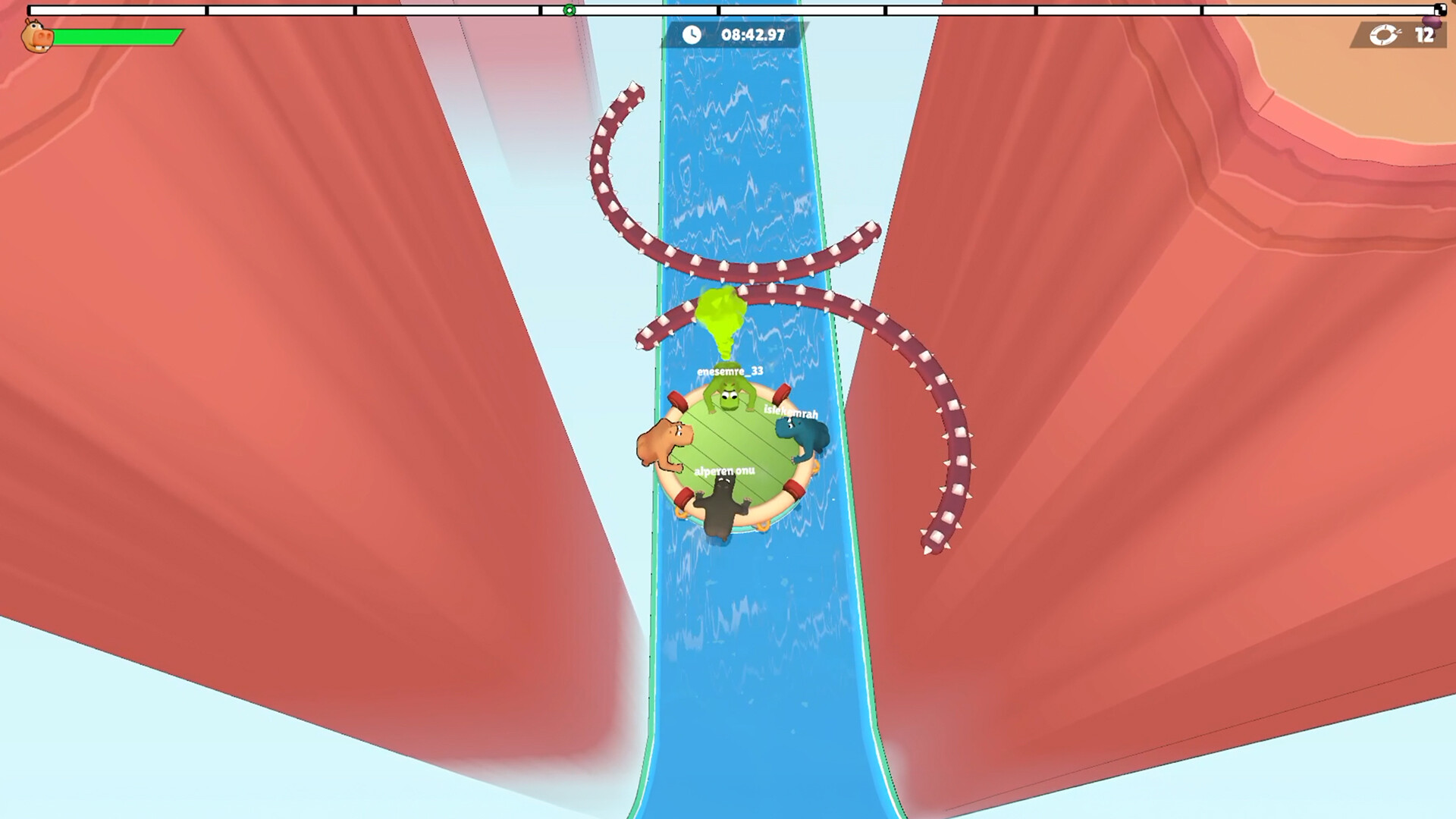
Official screenshot · Source: Steam store
Developed and published by GamesMrkt, Fart Together is a physics-based co-op obstacle game for 2–4 players. Everyone shares one raft, and each player’s force, direction, and timing affect its movement. Your group must navigate narrow passages, sharp turns, moving obstacles, and hazards that can throw the raft off balance.
Availability note: As of October 23, 2026, Steam lists an October 29, 2026 Early Access launch and a downloadable demo. This is a pre-release beginner’s guide based on the official description, not a hands-on walkthrough. Exact key bindings, lobby procedures, and level-specific solutions are not established in the supplied material.
What is confirmed—and what is advice?
The distinction matters because a useful tutorial should not invent controls or present theoretical strategies as tested solutions.
| Topic | Confirmed information | What this guide recommends |
|---|---|---|
| Player count | 2–4 players share a raft | Agree on communication rules before starting |
| Movement | Player force, direction, and timing affect the raft | Test individual inputs before combining them |
| Obstacles | Narrow routes, turns, moving obstacles, and destabilizing hazards | Plan an approach before committing |
| Co-op format | Online co-op is listed | Use a clear voice channel if available |
| Development | Physics, controls, and difficulty may be refined during Early Access | Recheck your assumptions after updates |
The central lesson is simple: more input is not automatically better input. When everyone reacts independently, even a well-intentioned correction can disrupt the team.
Before You Play: Availability, Controls, and PC Setup
Begin with the official Fart Together Steam listing to check the current release status, demo availability, and requirements. Early Access dates and features can change.
The listing includes both a Free To Play genre label and developer statements about lower Early Access pricing followed by a higher full-release price. Those details do not establish a clear launch price. Check the actual purchase options rather than assuming the full game is free because a demo is listed.
Check the system requirements
| Component | Minimum | Recommended |
|---|---|---|
| Operating system | Windows 10, 64-bit | Windows 10/11, 64-bit |
| Processor | Intel Core i5-8400 or AMD Ryzen 3 1200 | Intel Core i5-10400 or AMD Ryzen 5 3600 |
| Memory | 8 GB RAM | 16 GB RAM |
| Graphics | NVIDIA GTX 1050 Ti or AMD Radeon RX 560 | NVIDIA GTX 1660 or AMD Radeon RX 590 |
| DirectX | Version 11 | Version 11 |
| Storage | 4 GB available | 4 GB available |
| Network | Broadband; stable connection required for online co-op | Broadband; stable connection required for online co-op |
Steam lists a keyboard-only option and support for Xbox and PlayStation controllers. However, the supplied description does not identify individual buttons or explain how aiming and gas power are mapped.
Before attempting a course:
- Read any in-game control prompts and available control settings.
- Identify how your chosen input device handles direction and propulsion.
- Test what happens when you release an input.
- Make sure every teammate understands their own controls.
- Keep voice chat audible above game audio.
Custom volume controls are listed, so adjust the available audio settings if effects make communication difficult. Steam Deck compatibility is listed as Unknown, not verified.
This Fart Together tutorial deliberately avoids guessed keyboard shortcuts. Learning the actual mapping takes less time than unlearning an incorrect one.
Fart Together Tutorial: Your First Practice Session
Treat your opening attempts as experiments. You are learning how a shared object responds, not trying to prove which teammate has the fastest reactions.
The following drills are suggested practice methods, not official objectives or verified level solutions. Use a forgiving section if the available course provides one.
Step 1: Agree on what “left” means
“Go left!” is useless if one person means screen-left and another means their character’s left.
Choose a reference everyone can identify. If your views differ, use recognizable course features instead: “toward the opening” or “away from the moving obstacle.”
Also distinguish between the direction you want the raft to travel and the input a player should make. Until you understand the controls, those are not necessarily interchangeable instructions.
Step 2: Isolate one player’s contribution
Ask one teammate to make a brief input while the others avoid adding propulsion. Observe the result, then repeat with another player.
Look for:
- Which way the raft travels.
- Whether its orientation changes.
- How quickly the response becomes noticeable.
- What happens after the input ends.
Do not assume that stopping an input instantly stops the raft. Observe the behavior in your current build.
Step 3: Combine inputs deliberately
Once individual inputs make sense, try a coordinated action with two players. Compare that result with the earlier single-player tests.
| Practice drill | Suggested procedure | What you are learning |
|---|---|---|
| Individual input | One player acts while others hold off | Each player’s effect on the raft |
| Shared direction | Two players coordinate toward one agreed destination | How their contributions combine |
| Countdown | Act together after “three, two, one, go” | Whether timing improves consistency |
| Release test | Stop adding input on a shared call | How the raft behaves afterward |
| Small correction | Make one brief adjustment, then observe | How to avoid repeated overcorrection |
Step 4: Add the remaining teammates
For a three- or four-player group, introduce additional inputs gradually. This keeps the cause of an unexpected movement easier to identify.
For practice purposes, designate one caller and one observer. The observer can watch the next obstacle while the caller keeps instructions consistent. These are communication roles, not built-in classes or gameplay bonuses.
The goal of this Fart Together tutorial is not perfect synchronization on every action. It is knowing who should act, toward what result, and when.
How to Approach Turns, Narrow Passages, and Moving Obstacles
The official description emphasizes situations where teams must accelerate, slow down, or coordinate at a particular moment. That suggests a useful beginner habit: decide what the next section requires before everyone starts reacting.
Narrow passages: align before committing
A tight opening leaves little room for conflicting corrections. Identify the intended path and approach it with enough control to evaluate your alignment.
If the raft starts drifting away from that path, avoid having every player improvise a different fix. Let the caller request one adjustment, then assess its effect.
Do not treat this as a claim that every narrow section requires the same speed. The appropriate approach depends on the course and how the current build handles.
Sharp turns: look beyond the corner
Watch the exit as well as the turn itself. Your team needs to agree on where the raft should end up, not simply respond to the nearest edge.
A useful call might be: “Aim for the opening after the bend; small correction first.” That gives teammates a destination and limits the temptation to pile on unnecessary input.
Moving obstacles: observe the opening
When the approach allows it, watch a moving hazard before entering its path. Identify a visible opportunity, then coordinate your attempt.
Avoid assuming that every obstacle follows a perfectly repeatable cycle. Observation helps, but it does not establish a universal timing solution.
| Situation | Beginner priority | Suggested team call |
|---|---|---|
| Narrow opening | Establish alignment | “Opening ahead; small correction” |
| Sharp turn | Agree on the exit route | “Turn toward the exit” |
| Moving obstacle | Coordinate entry timing | “Wait for the opening—go” |
| Unexpected movement | Avoid competing reactions | “Hold input; assess” |
| Clear approach | Agree before increasing propulsion | “Ready together on three” |
Here, “hold input” means stop adding propulsion, not that the raft will necessarily stop moving.
For example, imagine your group approaching a narrow gap beside a moving obstacle. Instead of yelling “go” as soon as the gap looks clear, first agree on the route, check alignment, and establish who will initiate movement. The extra preparation makes the attempt easier to understand—even if it fails.
That is the practical obstacle-handling principle behind this Fart Together tutorial: reduce uncertainty before adding force.
Common Beginner Mistakes and How to Fix Them
Most useful practice comes from identifying a specific mismatch between intention and result. “We’re bad at this” tells your group nothing. “Two people corrected in opposite directions” gives you something to change.
| Mistake | Why it creates trouble | Better approach |
|---|---|---|
| Everyone gives directions | Players receive conflicting instructions | Use one caller during difficult sections |
| Everyone corrects at once | Multiple inputs make the result harder to predict | Assign the next adjustment clearly |
| Repeating an unsuccessful approach unchanged | The team learns little from the failure | Change one factor on the next attempt |
| Using vague directions | Players may interpret them differently | Name a visible destination |
| Blaming someone immediately | Discussion shifts away from the movement problem | Describe what happened before assigning a cause |
Use a short review between attempts
After a failed maneuver, answer three questions:
- What movement did we want?
- What movement actually happened?
- What single change will we try next?
For example: “We wanted to enter straight, but turned before reaching the opening. Next attempt, only one player makes the alignment correction.”
That is more actionable than asking everyone to “be more careful.”
Distinguish control problems from technical problems
If teammates report inconsistent responsiveness, do not immediately assume poor timing is the only cause. A stable internet connection is an official requirement, and performance problems can make coordinated play harder.
Check whether the issue also occurs during simple, isolated input tests. If it persists, note the build, hardware, input device, and circumstances before submitting feedback through the developer’s stated community channels.
This Fart Together tutorial is based on official pre-release information, not player experience or community reports. Early Access may change the feel of steering, so be willing to repeat your basic tests after an update.
FAQ: Fart Together Tutorial Questions
How many people can play Fart Together?
The official description specifies 2–4 players steering one shared raft, and Steam lists online co-op. The supplied material does not confirm solo play, local split-screen, or cross-platform multiplayer.
Does this Fart Together tutorial include exact controls?
No. The available official text lists a keyboard-only option and Xbox and PlayStation controller support, but it does not provide button mappings. Check the prompts and settings in your version before practicing the coordination drills.
Is Fart Together available now?
As of October 23, 2026, Steam lists the main game as not yet available, with a planned Early Access release on October 29, 2026. A downloadable demo is also listed. Check the current store page for changes and any demo-specific restrictions.
What should beginners focus on first?
Start with direction, individual input testing, and clear communication—not speed. Learn how one player affects the raft, then combine inputs deliberately. Once the group can explain its own movements, turns and obstacle approaches become much easier to practice without descending into four-person panic.
Related Guides
Fart Together first time: A Couple's Comfort Guide
Nervous about farting in front of your partner? Learn how to handle the first time, talk about boundaries, and keep an awkward moment comfortable.
Fart Together how to play: Co-op Beginner's Guide
Learn how to play Fart Together with friends, coordinate raft movement, tackle obstacles, and prepare your PC for the free Steam demo.
Fart Together raft Guide: Steering and Co-op Tips
Master the Fart Together raft with practical steering, timing, obstacle, and co-op tips. Learn what differs between the Steam and mobile listings.
Fart Together 2P: Two-Player Co-op Guide and Tips
Explore Fart Together 2P, including two-player support, online co-op details, teamwork tips, PC requirements, and the planned Early Access release.
Fart Together demo gameplay: Co-op Tips and Guide
Explore Fart Together demo gameplay, 2–4-player raft controls, teamwork tips, PC requirements, and how to download the free Steam demo.